

Weekly Updates: Improving Communication, Accelerating Decisions, and Crafting the Responsible Engineer
An unlikely ritual to improve company-wide SNR


TL;DR: Most teams struggle with communication — either too much, too little, or the wrong kind, leaving leaders without the signal they need to make good decisions. Weekly updates fix that. They are short, structured communication at the right cadence, cutting through noise and surfacing what matters. The result: clearer priorities and faster decisions. We also firmly believe that that the Weekly Update can serve as an easy gateway into the very foundations of the Responsible Engineer culture. This article explains why, and includes a template and worked examples.
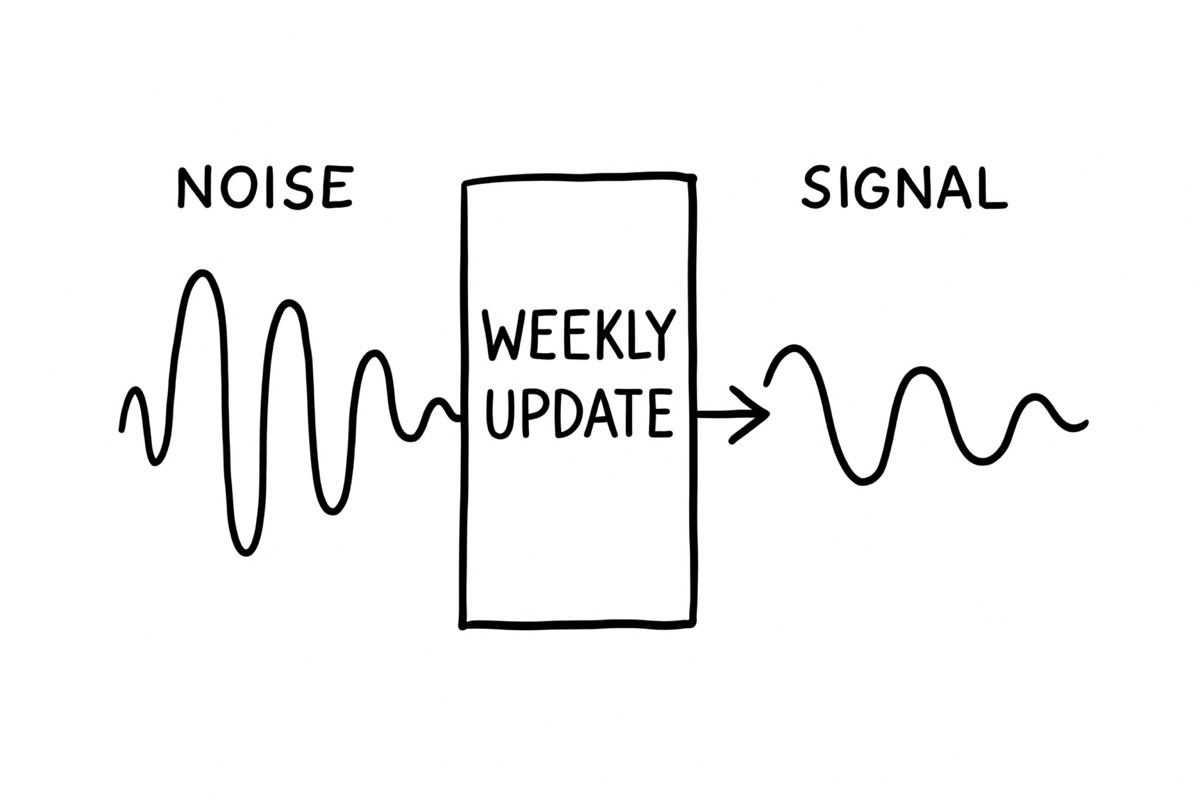
Communication → Prioritization → Decisions
At the core of building a fast-moving hardware company is the ability to separate signal from noise. Communication is the lifeblood of that system, but inside most organizations it is broken. There is either too much or too little of it, rarely the right kind, and almost never at the right fidelity. People push back on having to do it, and when they do, it often degrades into a check-the-box exercise. The result is noisy information, and noisy information means ineffective decisions. Every choice in a hardware company — from an engineer deciding what to tackle this week, to a manager allocating resources, to an executive deciding which risks to buy down — depends on clear, high-signal communication. Without it, management and leadership fail.
Most traditional reporting systems collapse under their own weight. Monthly management reviews become theater, where teams are more interested in showing they have been working than surfacing what really matters. Schedule review meetings turn into rituals of arbitrary percentages. “Status reports” devolve into lists of irrelevant detail, as people try to showcase themselves or get credit rather than communicate signal.
Weekly updates, when done right, flip that on its head. They are not about paperwork, they are about clarity. They are a lightweight system of structured communication that enables faster, higher-quality decisions at every level of the company. They allow information to flow up, down, and across the org, giving engineers focus, managers visibility, and executives the ability to lead with real context.
Why Weekly, Not Biweekly or Monthly
The cadence matters. Weekly updates work because they align with how people already think about time. Most of us naturally anchor around the work week. We break projects into chunks that need to get done before Friday, whether consciously or not.
Weekly also creates habit and is a routine you can lock in. Every Friday, you pause, reflect, and reset. Biweekly is harder to remember and too infrequent to keep the personal project management muscle sharp. Monthly is too slow, requires too much preparation, and by the time you notice a problem, you have lost weeks you cannot get back.
Weekly is the sweet spot. Fast enough to catch issues early. Slow enough not to overwhelm.
The rhythm also matters. Weekly updates provide a natural closure to the work week and a reset before the next. Friday reflection, Monday reset. Without that cadence, it is far too easy for projects to drift without anyone realizing.
What a Weekly Update Looks Like
A good weekly update is short, structured, and accessible. The basic template is:
Accomplishments: 3-5 points. Focus only on things that matter to others.
Top priorities for next week: 3-5 points. Specific and outcome-oriented.
Priorities for the next month or quarter: Up to about 5 dates tracked forward so, if they slip, cross them out in red; if they pull in, highlight in green.
Concerns or problems: 3-5 max. Blockers, risks, or dependencies.
Fun stuff: Photos, results, cool outputs, or team moments.
[Click here for examples and template]
This format applies to everyone, from interns to executives. Leads and managers use the same format, but aggregate their teams’ updates into a concise summary. The pyramid scales, but the general structure remains.
And yes, executives can and should participate in smaller, earlier stage startups. Everyone knows the CEO does not have to do this. But when they do, it sends a powerful signal of solidarity. It also gives junior engineers a rare and valuable window into the company’s top-level priorities.
A Forcing Function
The real power of weekly updates is not the updates themselves, but the reflection they force.
Every Friday, everyone has to stop and ask:
What did I actually accomplish?
Were those the right things?
What are the most important outcomes for next week?
Am I holding to my dates, or do I need to adjust scope or ask for help?
Often, these updates are the first time risks surface while they are still small. A delayed part order or a tricky test result might not warrant a formal review yet, but when called out in a weekly update, it gives leadership and adjacent teams the chance to help before it snowballs.
That reflection is a form of lightweight project management. It shifts the mindset from “tell me what to do” toward “here is what I need to keep us on track.” It is the Responsible Engineer mindset in action.
Over time, this builds a culture where engineers are not just executing tasks but actively managing their work against the larger system. This also trains engineers to think like managers, balancing priorities, weighing tradeoffs, and framing problems clearly. That habit not only makes them more effective in their current role but also builds the next generation of leads as the company scales.
From the CEO to the intern, weeklies deliver value across the entire org
For the author: Building this muscle every week leads to better decision making. Many times I have seen super talented people cranking hard on work all week long. They run around working their butt off, only to find that at the end of the week, the needle has hardly moved on their project. And it was not because they were lazy or incompetent. As silly as it sounds, many times it came down to the fact that they just did not identify their own critical priorities for the week, and stick to them. They might have put out some perceived fires, but those fires were not in line with the actual top priorities of the group or company. There is always an infinite amount of work that can be done, but those teams that move swiftly and effectively know how to keep their priorities in line and let some of those fires keep burning.
For the manager: It is impossible to make good decisions without good information. And getting a consistent source of concise, high-signal information is invaluable. As a leader, you have to know how your projects are doing. A long rambly update with a multitude of tasks being checked off makes it nearly impossible to figure out if the team accomplished what they were setting out to do, and if not, why it may or may not pose a problem. If you do not know that things are going poorly, it is impossible to provide assistance. If you do not know if your team is making effective progress, then you do not know if you are doing a good job as a leader.
Weekly updates also let managers spot patterns across teams. If three different groups mention the same dependency as a blocker, that is a signal the organization needs to address it. Updates are not just inputs flowing upward, they are feedback loops that only work if leaders take action on what is raised.
For adjacent consumers: In fast paced environments, adjacent consumers of the information need the barriers to information exchange to be as low as possible. If your update is just full of self-congratulatory back-patting, it makes it difficult for those consumers of the information to actually extract the key relevant changes or progress they need to know about to remain successful themselves. They do need to know if you changed the baseline design, or are even starting to consider alternatives because of a risk that was surfaced that week, or that things are simply on track and the data to have confidence it will remain as so. If that information can be conveyed succinctly and be easy to access, information flows freely, reducing the risk of silos and teams that drift to become extremely out of sync.
For everybody involved: Effectively communicating to those above you, beside you, and below you is a journey that never ends. It is also a skill whose only path to improvement is practice. Learning what information makes those around you most effective, and leaning into that for the greater good of the organization, is a muscle we all have to keep on top of. One size does not fit all and where one VP might want to see lots of detail, another CEO might only want the most minimal of updates.
Format and Tools
One critical principle: your signal is someone else’s noise, and vice versa.
What matters deeply to your team might be irrelevant to another. But the opposite is also true. The procurement delay that throws off your schedule might be meaningless to one team, and the single most important piece of information another team hears all week.
This is why accessibility matters more than distribution. Whether you use Slack, Confluence, or email does not matter as much as making sure updates are easy to find, easy to follow week over week, and easy to scale from the individual up to the company.
Threads work especially well, which makes email or messaging applications well-suited (although personally I find search on email works better than Slack). Each person has their own update thread, which makes it easy to scroll back and see their trajectory over time. Leads and managers can do the same for their aggregated updates. Weekly cross-team threads might be nice for the moment, but much harder to compare against the past.
Handling Resistance and Coaching Engineers
Not everyone will embrace weekly updates at first. Some will resist the practice outright. Others will do them, but fill them with either too much noise or too little signal. Both are normal, and both can be addressed.
First, this is not a self-regulating activity. Everyone must participate. Sure, someone might miss a week now and then, but consistency is what makes the system valuable. The responsibility for holding the line sits with leadership. Managers, leads, and maybe even the CEO must model the behavior. If they regularly skip or write poor updates, the practice collapses. If they consistently deliver clear, high-signal updates, others will follow suit.
When individuals struggle with the format, the key is to coach them with good EQ. For example, if someone writes updates overloaded with irrelevant detail, they are often compensating for insecurity. They want to prove they have been busy. The right coaching here is to remind them that updates are not about demonstrating effort, they are about communicating what matters for the project. The more clutter they add, the harder it is for others to understand what is really going on.
On the other hand, engineers who consistently under-share are rare. When it happens, it usually comes from rushing through the exercise and writing the bare minimum. If this happens only occasionally, do not sweat it. But if you or team members are having trouble understanding how the project is doing due to a lack of information, a gentle reminder in a 1:1 is usually enough to course correct.
And it is important to actually acknowledge and act on the issues your engineers raise. If several people consistently flag the same concern and leadership never takes the time to understand or address it, the message becomes clear: this is about process, not results. The culture shifts from “this is how we align and solve problems” to “this is just process.” That shift is toxic, it turns a high-signal tool into busywork.
If the practice starts to drift across the organization, the reset is straightforward: recommit to the discipline, explain the value, and lead by example. This is not about punishment or tracking. It is about enabling the company to prioritize resources, set realistic expectations, and keep projects moving forward.
Time Discipline
A good weekly update should not be a polished essay. For individual contributors, 15–30 minutes is a reasonable expectation. For leads and managers, who must read through multiple updates and distill them into a summary, it can take longer. That is okay. It is not wasted time, it is a project management checkpoint.
Some people may complain about not having even 15–30 minutes at the end of the week to reflect and plan for the next week. It is a fair concern when you are feeling totally overburdened. To those that feel that way, I present you a challenge: find me a single example of a highly effective and productive person (IC or leader) who advocates that the path to success is a series of weeks in which you start the week not knowing if the last week was an effective use of time, and what the plan is for the upcoming week. Just like the anecdote before of the grinding engineer spinning their wheels, this simple exercise can sometimes save you a whole week of wasted effort.
One practical tip: do not wait until Friday to remember everything. Keep a running draft during the week. Add bullets as you finish meaningful work or surface concerns. By the time Friday comes, polishing it takes just a few minutes, and you will not forget the small but important signals.
Fun Stuff
Never underestimate the value of the “fun stuff” section. Hardware is hard, and morale matters. Seeing photos of test setups, teammates running experiments, or even a birthday celebration helps everyone feel connected. Cool simulation outputs, funny but relevant memes, even quirky data points with photos (“the chiller made two inches of ice on the heat exchanger!”) all add color.
Leaders should reinforce this by highlighting fun stuff in all-hands or resharing the best moments. That small act signals that these updates are not just tolerated, but valued. Fun stuff connects people across silos and reminds everyone they are part of a bigger story than their own task list.
These do not advance the schedule directly, but they build culture. And culture keeps people motivated through the hard times.
Final Thought
Weekly updates are not a reporting chore. They are a cultural tool. They are a practice that builds reflection, prioritization, and communication into the fabric of your company. They create visibility without bureaucracy, accountability without micromanagement, and alignment without endless meetings.
They are not easy to sustain, take discipline and require leadership by example. But if you commit to them, they are one of the highest-leverage habits you can establish in a growing hardware organization.
They are more than just a reporting tool, but the heartbeat of a fast-moving engineering org. They are the Responsible Engineer mindset in action.
Template & Examples
Check them out here.